


Don't Miss Out
Join Our AAAS-IUSE Community
If you are a current NSF Improving Undergraduate STEM Education (IUSE) award recipient, interested in submitting an award proposal, or involved in STEM undergraduate education, you’ve come to the right place!
We invite you to engage with this initiative which provides opportunities to showcase your work, disseminate research, and collaborate with STEM leaders.
Featured Opportunity
NSF IUSE Panelist Availability Survey 2023-2024
This survey is for persons interested in serving on panels to review proposals submitted to the National Science Foundation’s Division of Undergraduate Education Improving Undergraduate STEM Education (IUSE) program. This survey will be used to identify panelists for meetings in September/October 2023 and February/March 2024.

Showcase Your Work
Is your research transforming STEM education at the classroom or institutional level? We want to hear from you! This initiative features opportunities to speak, author and share your resources.
What’s New
Blog Posts
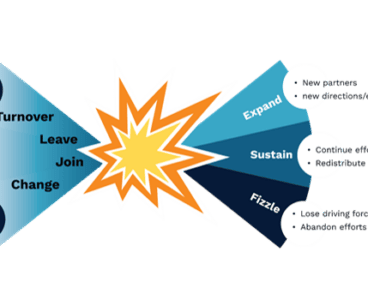
Expand, Sustain, or Fizzle? How to Support Institutional Change Efforts in STEM Throughout Personnel Turnover
Figure 1: Personnel turnover can occur in different ways and impact how institutional change efforts expand, sustain, or fizzle out. View full size.What we are…
Blog Posts
Increasing Undergraduate Research Capacity by Creating a CURE-to-Independent Research Pipeline: Benefits of Faculty and Student Professional Development
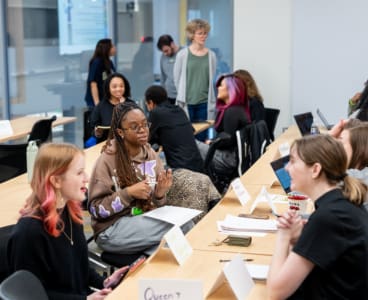
Caption: MD HIRES students and faculty practicing their “elevator pitches” about their research. View full size here.Undergraduate Research Experiences (UREs) …
Workshop
Innovation and Sustainability in STEM Education
Engage with three leading educators as they introduce innovations into STEM curricula that resonate with a wide range of learners. The presenters will share th…

Must Reads
Levers for Change 2023
Enacting a National Agenda for Undergraduate STEM Education
AAAS with support from the NSF, gathered educational researchers, professional society representatives, and administrators to discuss the state of undergraduate STEM classroom practices and to imagine its future. The organizers asked the participants to identify existing barriers that inhibit the uptake and adoption of evidence-based teaching practices across the country. This report provides recommendations to support educational reforms nationwide.
Levers for Change 2018
Leaders in STEM know a great deal about effective evidence-based teaching practices; yet there are widespread barriers to the adoption of these practices. AAAS, with support from the NSF and the Howard Hughes Medical Institute, engaged Sandra Laursen (University of Colorado Boulder) to lead an evaluation of the state of instructional reform across STEM fields.
Vision and Change 2017
Unpacking a Movement and Sharing Lessons Learned
In 2017 a Vision and Change (V&C) meeting was convened to unpack the V&C movement in terms of both the degree of penetration across the discipline, and the impact and results of adapting the principles laid out in the original document. The planning meeting was designed to help participants develop working hypotheses about the impact of V&C, to identify relevant stakeholders who may have perspectives about the impact, and to brainstorm possible relevant data and methods for collecting and analyzing relevant data
Vision and Change 2015
Vision and Change 2015: Chronicling Change, Inspiring the Future
In 2013, a national convening of 189 colleges, universities, and organizations met to explore how change happens in undergraduate biology education. Participants noted that although changes in biology often happen with lightning speed, changes to educational practice and the curriculum require both time and patience. But participants also emphasized that although curricular change occurs slowly, with a clear vision and leadership, change is possible. Indeed, it is occurring nationwide.
Vision and Change 2009
A Call to Action
A revolution is underway in biology. The major focus of the biological sciences – understanding life – remains the same, but the science has experienced a major transformation. Breakthrough discoveries cross disciplinary boundaries, changing the nature of the questions asked. Thanks to advances in neurobiology, educational psychology, and evolving theories of learning, researchers have a better understanding of how students learn, allowing faculty to more effectively introduce biology to undergraduates and assess their learning.
