Author(s):
Author(s):
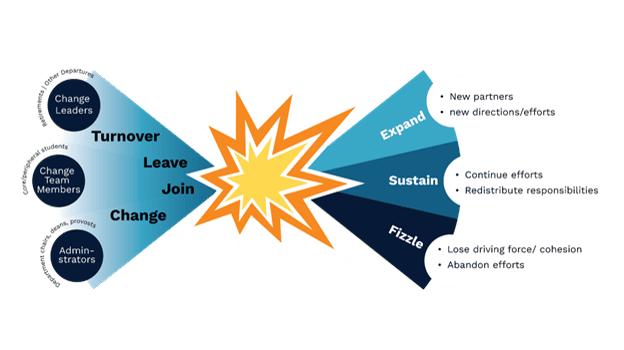
Figure 1: Personnel turnover can occur in different ways and impact how institutional change efforts expand, sustain, or fizzle out. View full size.
What we are learning from over 100 change agent teams in transformational STEM projects.
Change efforts within STEM education have largely been undertheorized and ineffective, prompting researchers to turn to business literature on organizational leadership to better understand and guide change efforts1,3,5. One major concern to the sustainability of any change effort is personnel turnover. Businesses intentionally focus efforts on planning for, weather, and leveraging turnover, but change agents in higher education are less familiar with the need to do so. Those involved in change efforts – change agents – in higher education are often faculty with little training on how to handle changes in project personnel, document “institutional knowledge” of projects, or onboard new members authentically. When forming change teams, leaders often identify other potential change agents by leveraging prior working relationships and professional networks, rather than by thinking deeply about the specific skills and responsibilities needed in change efforts2. A recent study by Margherio and colleagues 2highlights a connection between change agent turnover, leadership structures (e.g., distributed vs. centralized), and the extent to which team members share a common vision for change. However, more work in a variety of contexts needs to be done to understand how these components, and other facets of change agent turnover, are related.
Initial Work to Understand Change Agent Turnover
Over the past decade, we (the authors) have been involved in multiple local and national STEM education projects centered on institutional change efforts. Each of these projects has involved multiple change agent teams, the efforts of which we have studied and documented to identify conditions and strategies supporting sustainable change efforts. In these analyses, we have identified change agent turnover (CAT) as key events that determine the trajectory of change efforts:
- Turnover can expand change efforts (e.g., when newly hired faculty implement and share innovative teaching practices
- Turnover can sustain change efforts (e.g., when an incoming department chair is supportive, but largely remains peripheral to ongoing change efforts), or
- Turnover can change efforts all together (e.g., if the change effort leader leaves, or a new administrator shifts priorities)Though we have identified impacts of CAT, within these projects (and the field as a whole) the phenomenon of CAT is understudied. So far, we have identified four critical domains relevant to CAT:logistics and documentation, processes, communication, and culture, and associated guiding questions that teams should consider to support change efforts through CAT (see Table 1).
Table 1. Smith & Franz (2025)4 questions to guide change teams in planning for personnel turnover
|
Domains to Sustain Efforts through Turnover |
Related Questions for Teams |
Logistics and Documentation
Files, notes and decisions, access to documentation |
|
Processes
Setting agendas, decision-making, revising goals and strategies, distribution of responsibilities |
|
Communication
Internal and external, multiple modes, transparency, inclusion |
|
Culture
Norms and agreements, trust, relationships, support |
|
In addition to these domains, it is important to recognize that turnover is inevitable, and so all change teams should plan on ways to recruit others to their cause. Change agents might focus recruitment efforts on the importance of the change work locally: how projects/efforts are (or could be) viewed, valued, and aligned with job responsibilities. Some questions change agents might ask:
- Who is leaving or joining?
- What are their roles/responsibilities?
- What knowledge, skills, connections, and power do we need to replace?
- How will we learn about new people’s knowledge skills, connections, and power?
- How do we on-board new members?
Sustaining Undergraduate STEM Transformation And Improvement Networks through Change Agent Turnover
We are continuing this work through our new I-USE, Sustaining Undergraduate STEM Transformation And Improvement Networks through Change Agent Turnover (SUSTAIN-CAT; NSF 2518434) which investigates why and under what conditions change teams are able to sustain or expand their work through turnover. This involves understanding team processes (i.e., what teams do), such as how teams distribute power among their members, the ways in which they communicate, or more broadly the iterative change process in which teams engage. It also includes understanding relationships among team members, including the level of trust that exists among members and the processes used to build and maintain that trust. Teams codify and document their efforts through structures or products, such as onboarding documents, community agreements, designated roles, or shared folders.
Based on preliminary findings, we recommend change teams create a written turnover plan that attends to logistics and documentation, processes, communication, and culture with consideration for different responsibilities of people who may leave, join, or change roles (team leaders, team members, and administrators).
The purpose of this grant is ultimately to pilot and finalize a toolkit that change agent teams can use to create a well-formed turnover plan that supports their change efforts through periods of personnel turnover. SUSTAIN-CAT is examining data from 118 change teams, all of which have experienced turnover in some form (team leaders, team members, and/or administrators).
One Story About Change
We illustrate some preliminary findings by telling part of the story of one institutional change team we are calling Urban State University (USU). The initial USU change efforts were to implement greater course coordination for introductory mathematics courses, going beyond a common syllabus and textbook, to include common topics, shared materials, course coordinator roles, and common assessments. The USU mathematics department was quite successful in these change efforts, ultimately hiring dedicated course coordinators, creating common materials shared with instructors, and enacting common assessments, all through an administrative “churn” with multiple new university presidents, college deans, and department chairs.
Communication & Onboarding
USU leveraged existing departmental structures and norms to communicate about change efforts within the department (e.g., department teaching conversations, curriculum committees, and informal hallway conversations). The team explicitly focused attention on how to get faculty buy-in, by focusing on how changes made faculty lives easier. One of the change agents was also an administrator, and so advocated for change efforts in their role. This change agent’s proactive communications with administrators helped to garner and sustain resources for the department’s change efforts, including dedicated course coordinator positions.
Culture (Recruitment & Onboarding)
In 2020, the department hired three clinical faculty to serve as course coordinators, as well as hired multiple new instructors. This presented the change agent team with an opportunity to establish new instructional norms that supported coordination. As one leader explained: “We had a ton of new people and so we were excited to get them in place so that the people coming in would view coordination as a normal thing.” The team planned a series of online meetings to mentor the new coordinators and onboard the other new hires. Change agents at USU also shared that they positioned themselves to serve on department hiring committees, to further their goals: “when looking to hire coordinators, [we] wanted people who have active learning experience” (Fall 2020 interview).
Processes
The USU team discussed how they would share responsibilities of project leadership and activities, such as agreeing to rotate the initial course coordination responsibilities among their change agent team. When we observed them meeting, the USU team had a clear leader but also had fostered a climate where everyone contributed to the discussions.
Logistics
Largely because the past interviews were not specifically designed to capture elements of and responses to personnel turnover, the change agents at USU didn’t share lots of logistical details. They did discuss how they created shared folders they put on a university server to share with all instructors. They also discussed how they might make the shared folders more robust to turnover, since the folders were attached to individual faculty accounts.
Conclusion
Change is a constant in higher education. Change teams that proactively plan for accommodating CAT are better positioned to weather changes and even use turnover to accelerate change efforts. Change teams need to document processes and update them regularly. While this work is not easy to make time to do, it can help a change team to sustain their efforts through upheavals caused by (inevitable) personnel turnover. Look for our project to launch a CAT toolkit pilot in Fall 2026, expanding on these domains of attention to help provide teams with practical guidance.
Acknowledgements
We are grateful for the data analysis contributions of colleagues on our team, Camilla Morone, Molly Williams, and Katie Wilson, which have informed our preliminary findings. This project is funded by a grant from the National Science Foundation (Award #2518434). Any opinions, findings and conclusions or recommendations expressed in this material are those of the author(s) and do not necessarily reflect the views of the National Science Foundation.
Author(s)