
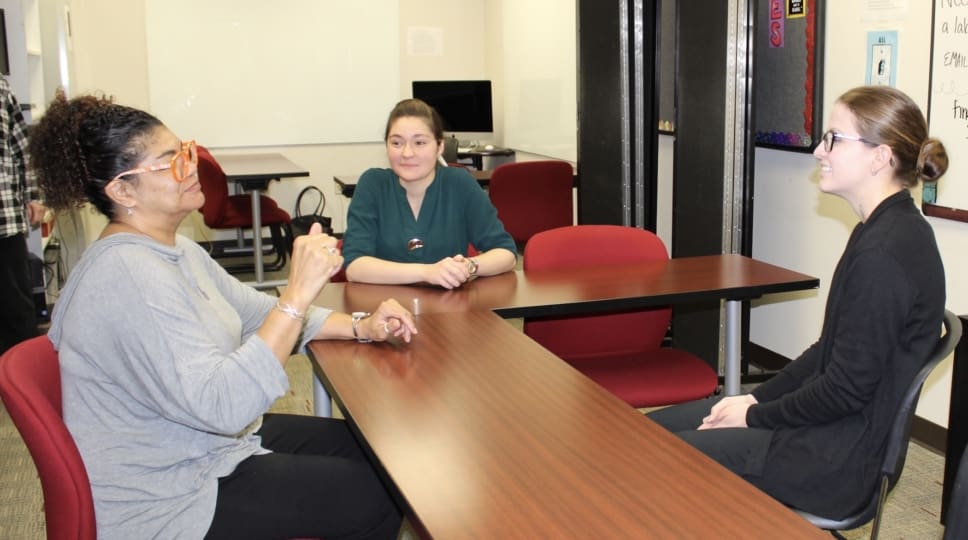
Additional Authors: Cristophorus Budidharma, Graduate Student, Lamar University; Ashley Greene, Assistant Professor, Gallaudet University; Sean Hauschildt, Assistant Professor, Lamar University
While progress has been made in increasing participation in STEM, data show that fewer people with disabilities are represented in STEM education and employment compared to their representation in the U.S. population.1 Specifically, individuals with disabilities represent 9% of the U.S. population and only 3% of the STEM workforce; they experience a lower level of career success when compared with their nondisabled peers and are less likely to complete a college education.2
Regarding persons who are deaf or hard of hearing (DHH) and their participation in STEM, roughly 15% are in specialized schools and programs. These students rely on teachers and interpreters who communicate with them in American Sign Language (ASL). The remaining 85% are mainstreamed in general education3, 4 and rely on interpreters. In both cases, interpreters often do not know the signs for the scientific terms being used. Consequently, language becomes an impediment to science learning and results in DHH students being poorly prepared for studying STEM at the undergraduate level, where the technical nature and vocabulary of STEM disciplines increases.5, 6 These factors may also discourage those who are interested in STEM from enrolling in postsecondary STEM programs.7 This is further complicated by a lack of qualified sign language interpreters with knowledge of STEM content or without STEM-related training or experience, resulting in their interpretation often containing errors.8-11 The interpreters who are available tend to rely heavily on letter-for-letter fingerspelling and word-for-word transliteration.12
To address the problems of interpreters not knowing the signs and meaning of scientific terms used in interpretation of STEM content, not having knowledge of STEM content, and relying on letter-for-letter fingerspelling and word-for-word transliteration, TERC and Lamar University engaged in a series of IUSE projects that focused on undergraduate students studying to be interpreters. To address the problem of interpreters not knowing the signs for scientific terms used in introductory biology lectures and the meaning of these terms, their first award focused on developing a prototype Signing Bioscience Dictionary (SBD). This involved use of TERC’s Signing Life Science Dictionary (SLSD) to identify signs and meanings of a set of terms used in the study of biology at Lamar. This dictionary, for grades 9-12 and undergraduates, incorporates a SigningAvatar® that signs on demand the English-text version of the term and its definition. Results of this first initiative showed that the knowledge of life science vocabulary of student interpreters who participated in the study and their ability to sign it increased significantly with use of the SBD.
To further address the problems of interpreters not knowing the signs and meaning of scientific terms used in interpretation of STEM content, their second IUSE award involved transitioning the prototype SBD to a beta version. To address the problem of interpreters not having knowledge of STEM content, development included creating summaries of core biology content for use in conjunction with use of the SBD. To enable interpreters to use fingerspelling that is not letter-for-letter and to avoid word-for-word translations, additional development included producing videos explaining the principles of fingerspelling and the application of these principles to STEM vocabulary encountered in undergraduate biology lecture material. Test results showed the knowledge of life science vocabulary of student interpreters who participated in the study, their ability to interpret typical biology lecture material, and their fingerspelling improved significantly with use of the SBD and the videos. They also showed no significant improvement in knowledge of biology content. This problem would likely involve increasing the science requirement required for graduation from the Interpreter Training Program or some similar strategy. Addressing it would require considerable additional research that is beyond the scope of the project. For this reason, further integration of biology content into our innovations was abandoned. An additional finding was that participants reported they would like to have an SBD that incorporates a human signer.
With their third award, development activities converted terms in the SBD into a Signing Bioscience Lexicon (SBL) that incorporates a human signer signing the terms, finalized the fingerspelling videos, created tutorials to accompany them, and implemented the final set of materials at another university. Research activities involved tracking use and effectiveness of the SBD, SBL, fingerspelling videos, and tutorials with interpreting students. This focus continues to seek to enable interpretation of undergraduate biology lecture content fluently and accurately by addressing the problems of interpreters not knowing the signs and meaning of scientific terms used in interpretation of STEM content as well as their use of letter-for-letter fingerspelling and word-for word transliteration.
In this blog, we take a closer look at how the SBD, SBL, and fingerspelling videos research and development address the problems interpreters are having interpreting undergraduate biology lecture material.
Prototype Signing Bioscience Dictionary Development and Research
To address the problem of interpreters not knowing the signs for scientific terms used in an introductory biology lecture and the meaning of these terms, development of the prototype SBD involved examining the glossary entries in the text used at Lamar in their introductory undergraduate biology course. With the list of terms as the starting point and using the SLSD as the source of signed versions of the terms and definitions, ~750 SLSD terms were identified for inclusion in the SBD. The SLSD interface was also revised into an on-demand version for integration into the SBD. This feature allows users to access definition pages by typing into a search box or selecting from alphabetical lists; select information represented as static images, text, human-voice narration and/or signing; and increase or decrease text size.
Research focusing on use and effectiveness involved a study sample of 26 Lamar undergraduate interpreting students. Most of the students found the SBD features helpful and easy to use. They were generally satisfied with the information available for each term, with the accuracy of the signs and with their ability to understand the avatar. Pre/post-use change scores showed its use resulted in students’ strengthened knowledge of bioscience vocabulary. The paired tests for the vocabulary and signing change confirm that both knowledge of the vocabulary and ability to sign it increased. However, despite these improvements, they also show students were unable to apply this increased knowledge to accurate and fluent interpretation of a biology lecture. Many made sign-production errors while interpreting, used signs that were conceptually inaccurate, incorporated use of almost no classifiers, and were unable to effectively set up items in a spatial grammar. Their fingerspelling was also choppy.13 These issues were addressed in the context of our second IUSE award.
Beta Signing Bioscience Dictionary, Content Summaries, and Fingerspelling Videos Development and Research
To further address the problems of interpreters not knowing the signs and meaning of scientific terms used in interpretation of STEM content, development of a beta SBD involved putting the terms into content categories and enabling terms to be searched from a category of interest. Addressing the problem of interpreters not having knowledge of STEM content, involved creating summaries of key biology content using topics that emerged from review of the definitions and terms included in the content categories. Introductory texts used at Lamar and material and images the TERC team had previously researched and developed were used to ensure relevance and accuracy of the summaries. To address issues associated with interpreters’ use of fingerspelling, development included creating several videos to teach interpreting students how to fingerspell comfortably and naturally using syllabification and co-articulation.14 It also involved creating an interface to enable on-demand viewing in sign with or without captions; listening to what is being signed in English with or without simultaneous sign or voice overlay; increasing or decreasing text size, loudness, and contrast; or playing and replaying all or part of the video as often as needed. The SBD can be accessed from this website.
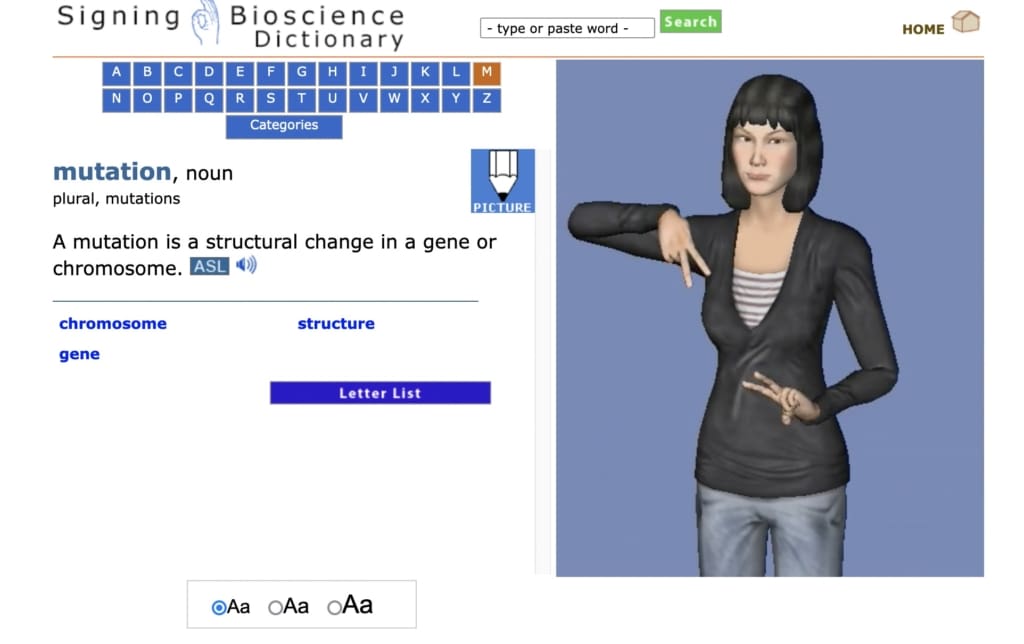
Image 1: An SBD Page
Image 2: Students Practicing Signing
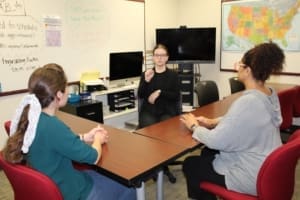
Image 3: Students Learning Signs
Research involved conducting a two-phase study with 24 undergraduate interpreting students. During Phase I, they studied selected SBD vocabulary and content. During Phase II, they learned and became able to use syllabification in signed fingerspelling. A video narrative of a spoken lecture was used to determine effectiveness and accuracy of their interpreting ability using a pre- and post-test design. Results show students’ knowledge of biology vocabulary was significantly improved with use of the SBD [t (23) = 8.14, p,.001; mean pretest=8.23 and mean posttest=36.56]. Their ability to interpret typical biology lecture material was also improved [t (23) = 3.83, p,.001; mean pretest 2.5 and mean posttest=12.5]. After watching the videos and working with the research team on applying those principles, fingerspelling scores significantly improved [t (23) =1.81, p=.04; mean pretest=9.8 and mean posttest=11.6]. There was no significant improvement in knowledge of bioscience content.15 Additional results from survey data show students used the SBD to look up terms and definitions in ASL and English; see words signed; and learn new signs. An additional finding was that they would like to have an SBD that incorporates a human signer rather than an avatar.
Signing Bioscience Lexicon, Additional Fingerspelling Videos Development, and Research
To further address the problem of interpreters using letter-for-letter fingerspelling and word-for-word transliteration, our third award involved converting terms in the SBD that are fingerspelled into a Signing Bioscience Lexicon (SBL) and finalizing the fingerspelling videos. For the SBL, the team reviewed the SBD category terms to identify those that incorporate fingerspelling. Five deaf and native signers then worked with our partner, Bridge Multimedia, to videorecord each person signing these terms. Captioned video files and audio recordings of each of the terms were then delivered to TERC for integration into the interface. This resulted in a ~500 term SBL without definitions that incorporates a human signer. The SBL can be accessed from this website.
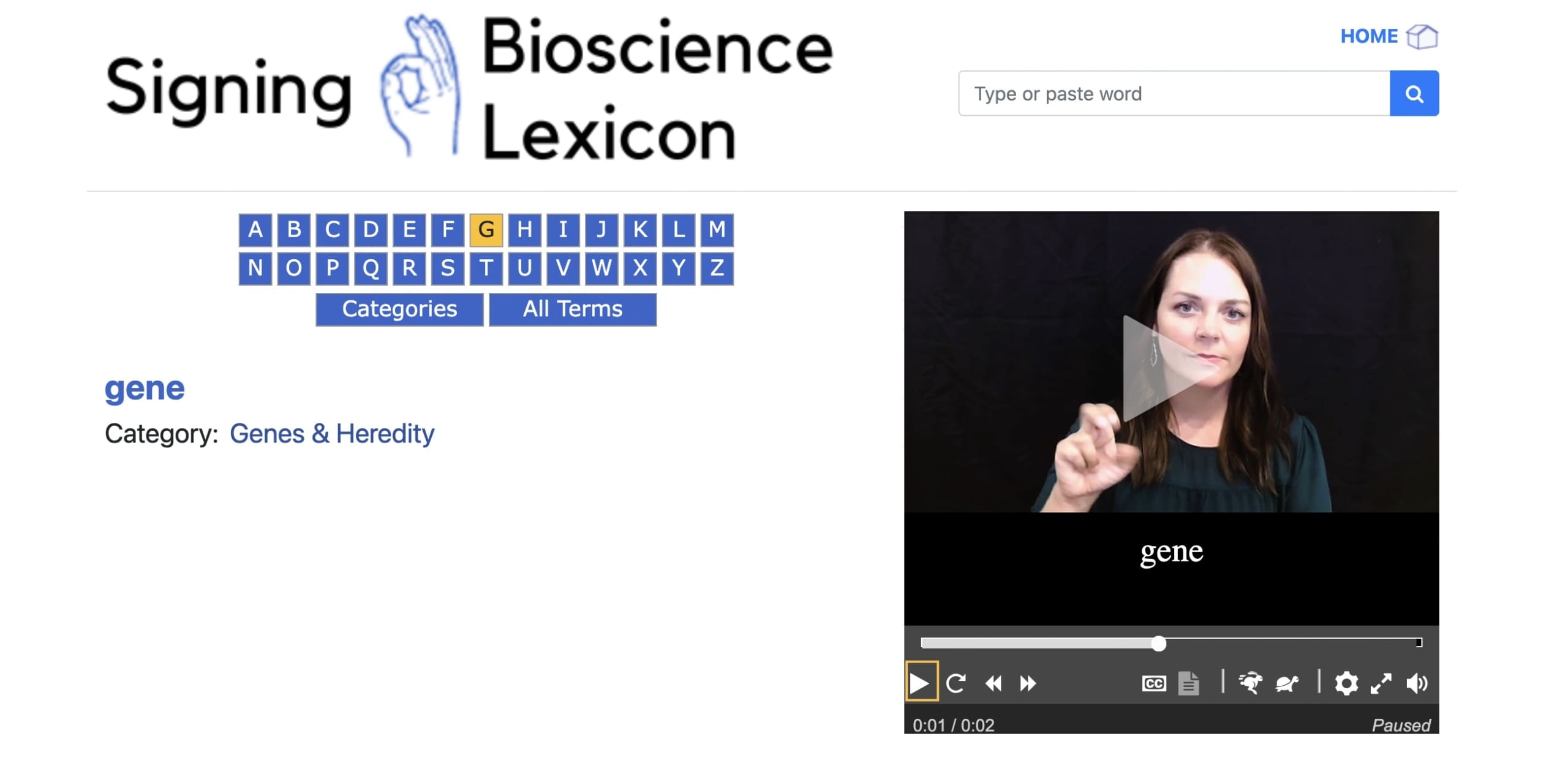
Image 4: An SBL Page
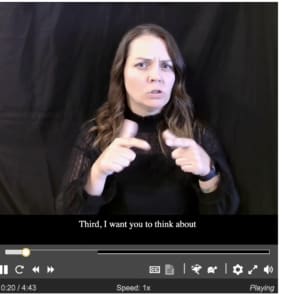
Image 5: A Video Page
Finalizing the fingerspelling videos involved creating an interface with options to play, rewind, restart, and move forward at any time; hide or show closed captions; view a transcript; increase or decrease speed; specify preferences; enable full-screen mode; and/or listen to an English version while viewing it in sign. After using the videos, one first year ASL student was so excited, she came up to the researcher and stated, “This makes fingerspelling so much easier.” Several upper-class students expressed concerned that they had been taught incorrectly before transferring to Lamar. ALL students told others in the department that they should have participated in the research and had a chance to use the materials. The videos can be accessed from this website.
Dissemination and Implementation
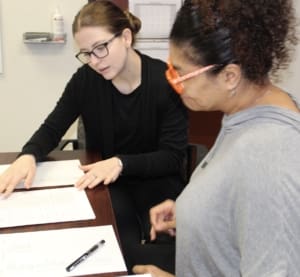
Image 6: Pre- Post-use Testing
Dissemination to date involved implementation of the SBD, SBL, and videos with interpreting students at another university. For those of you who might like to implement the innovations with your interpreting students, we have provided a few strategies to help you get started:
- Have the department chair lead or, at a minimum, support incorporating them into the program.
- Review the materials and decide which classes and teachers to involve.
- Decide to include all of the students they teach or only volunteers.
- Fulfill your school’s requirements for working with human subjects.
- Pick an SBL category to use.
- Decide how teachers will measure students’ pre- -use ability to accurately sign the terms in the selected category.
- Have them sit with each student and ask them to sign the terms and record yes or no as they go.
- Decide on the method they’ll use to measure students’ pre- ability to fluently and accurately interpret biology lecture material.
- Consider taping a section of a lecture or creating a mock lecture.
- Have teachers ask each student to interpret the lecture and record specific problem areas.
- Have teachers implement the materials.
- Using the same instruments as prior to use, have teachers examine students’ post-use ability to sign the terms in the selected category and to accurately and fluently interpret biology lecture material.
- Compare results for a measure of what they have learned.
Rather than deciding what to do on your own, consider contacting one of the blog authors and set up a Zoom meeting to help you get started. Consider setting up a second meeting with teachers to help them incorporate the materials. Another option would be to set up or series of workshops. Having as many trained interpreters as possible, who are able to interpret STEM content effectively and accurately, will be major step forward in enabling DHH to have access to STEM content.
Acknowledgements
Funding provided by NSF Awards: 1703343, 2019843, and 2313816. Any opinions, findings, conclusions, or recommendations expressed in this material are those of the authors and do not necessarily reflect the views of NSF.
Author(s)


